Jane Friedman, a publishing industry expert upon whom I rely for trustworthy information recently updated her very helpful guide to hybrid publishing. For anyone considering this publishing route, be sure to read this guide carefully as she outlines many of the warning signs when you consider signing with a hybrid publisher. I also recommend this list from ALLI, which analyzes the companies and individuals eager to help writers in all sorts of ways from editing to publishing to publicizing. This article in Publishers Weekly details the more successful hybrid publishers and their payment models. And finally, I always encourage writers to sign up for the regular emails from Authors Publish. Here is an article on what the author, Emily Harstone, calls the three kinds of publishing. To be clear, she does not distinguish between vanity and hybrid publishing.

But as a fiction writer, I always believe that “the devil is in the details” and so let me tell you the story of one writer’s experience with a hybrid publisher.
Geoffrey Douglas is an accomplished journalist and memoirist. You can sign up for his Substack newsletter, 5000 Bylines Later here. He modestly describes himself as “author and journalist, with six books and 100 or so magazine pieces behind me–about politics, people, gambling, migrants, murder, a town on fire, etc.” The five books he wrote before his current novel Love in a Dark Place, were all traditionally published, well-reviewed and one was turned into a movie. This novel certainly deserves to be. Kirkus Reviews calls it “…a moving, unflinching novel about human depravity, and the way love can coexist in its menacing presence… emotionally hard-hitting, with impressive psychological depth.”
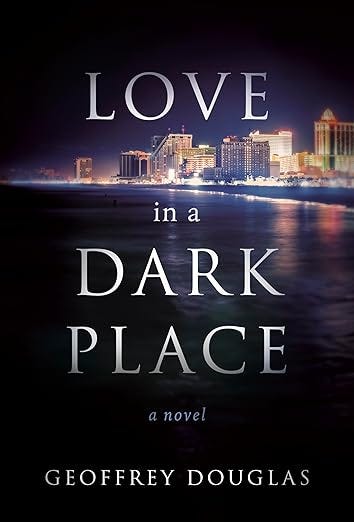
However, when Geoffrey tried to interest an agent in this novel based on his real-life experiences in Atlantic City during the 1980’s, the heyday of corruption and criminality, he couldn’t get anybody to sign him on. Those who did take a look at the manuscript were unnerved by a white male author “daring” (irony all mine) to include a prostitute and a black boxer as two of the main characters, both seen through the eyes of the protagonist. (I could go off on a tangent about the politically correct atmosphere in publishing these days when writers are pushed to stay within their very narrow lanes and only write what they know personally. What happened to imagination? But I digress.) With the big 5 (as the traditional publishing companies are known) only reading manuscripts from agented writers, the doors to publishing the old-fashioned way are slamming shut. This has pushed writers like Geoffrey to seek other ways to get his work out to a wider audience and there are a multitude of companies eager to help writers frustrated with the current system. Some of these are reputable, others not so much. (Once again see the ALLI guide above.)
So, when I asked Geoffrey about his experience with a hybrid publisher, he gave me this overall view of Greenleaf, the company he worked with.
For me, there were two sides to the coin. On the one hand, Greenleaf is a solid, very professional publisher. The editing, design and production of my book were all fabulous: professional, collaborative and endlessly helpful–more so than anything I ever experienced with the mainstream guys who published me before. And the final product is as fine as anything I could’ve hoped for.
The flip side: Although everyone I dealt with was very straightforward, and there was no dissembling as such, the system itself seems almost designed to obfuscate. The numbers you see on the front end are nothing like the final reality. You’re given a set of prices and a menu of options, most of which seem reasonable enough–but no mention is made initially of printing, warehouse storage, delivery to bookstores or a number of smaller services–so, probably like many other authors, I was blindsided by a lot of it. Some of their promotional options don’t seem worth the cost; and the print-run they recommended was far greater than what’s been sold so far or what I now anticipate. But because the number was more or less in line with my past experience with traditional publishers, and because it was their “professional recommendation,” I took the advice, and am now stuck with a monthly storage bill for more than 2,000 books—not to mention the original printing costs.
So my verdict is mixed. Great service, not so great communication. The system, as designed, is almost certain to include some pretty big potholes, even for the most cautious of us. It’s a textbook case of Buyer Beware. I didn’t beware nearly well enough, so that’s on me.
And here’s an assessment of Greenleaf by ALLI (Alliance of Independent Authors) which seems in line with Geoffrey’s experience.
High pressure sales and staggeringly high fees for add-on services tarnish an otherwise excellent service.
These days with the proliferation of pitfalls for writers and the come-ons from AI generated “publicists and editors” as I wrote about recently, it’s sadly become a game of “gotcha!”
I now feel compelled to add a note at the end of this post letting my readers know that this newsletter is and always will be “human authored.”